2026-11-28 · manager · 1,542 words · 1 citation
We ran our first post-training comparison. A simple average still wins.
TL;DR. On 2026-11-28 we trained two new candidate predictors on 64,000 human-rated pairs and scored them on the same frozen test cases as every earlier attempt. Neither beat the baseline that predicts from training-set averages: the prior scored 22/37 (59.5%) strict accuracy with mean regret 0.1243, the new arms scored 17/37 and 16/37. Six trained arms have now failed this gate, so the average stays in production, and we publish the negative result with its full receipt.
For: teams training or fine-tuning a model that has to beat a simple baseline before it ships, and anyone who has watched a validation win evaporate on a frozen test set. It assumes you know what a train/validation/test split is; everything else is defined where it is used.
The problem: a training claim we could not cash
Our behavior model, Manager, has one job: predict which of two candidate messages a person will respond to better, so the intervention we send is the better one. In November 2026 our own tracking said the model's bottleneck was training data and that post-training had not produced a candidate that beats the prior — the predictor that picks whichever candidate has the higher average human score in the training data. An issue in our tracker (opened by a teammate, unowned for weeks) asked for the first post-training run to start, with one acceptance rule: a candidate replaces the prior only if it beats the prior on identical frozen conditions.
That rule is the whole story. Averages are hard to beat honestly, because the average is computed from the same human judgments the trained model learns from. What follows is how we ran the comparison, the two ways our first attempts at comparability failed, and the result.
The benchmark is MaMe-Re (CyberAgent AI Lab): 250 scene contexts from a manga, 400 candidate panels, every pair rated by five people, the score being the share who found the panel funnier. We use only the columns its CC BY 4.0 license covers. It is an offline research benchmark, not product data — a limitation we return to below.
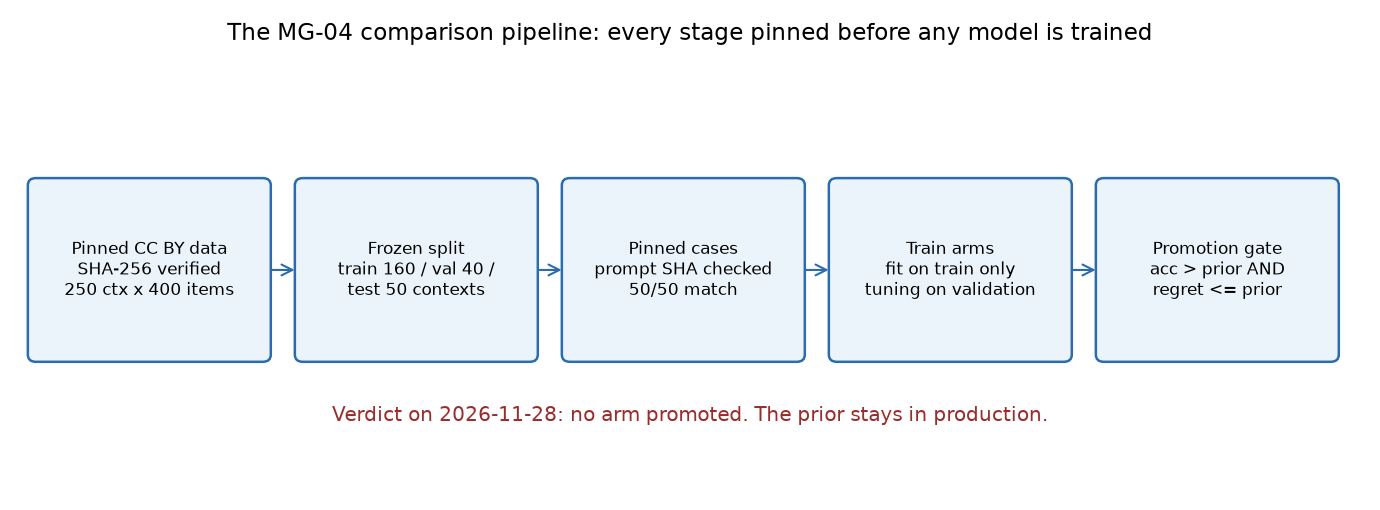 Figure 1 — The comparison pipeline: pinned data, frozen split, pinned cases, arms trained on the training split only, and a promotion gate fixed in advance. Source: our run record, 2026-11-28. Read: no stage may change after training starts; if a stage changes, the run is discarded.
How we did it
1. Pinned the data. We downloaded the three dataset files from a pinned upstream commit and verified SHA-256 hashes against the values recorded in our harness (score.csv aad13533…, context.csv 9bcacaf1…, image.csv 4067278c…). All three matched.
2. Froze the split. 160 training contexts, 40 validation, 50 test, from the split manifest frozen upstream on 2026-11-07. The test set yields 50 cases, of which 37 are non-tied (the two candidates have different human scores).
3. First failure — a retyped prompt. Our first attempt rebuilt the evaluation prompt from memory. The prompt hashes did not match the pinned case manifest in the earlier run's receipt, so we discarded the attempt and copied the prompt template verbatim from the canonical harness source. After that, all 50 test prompts matched their recorded SHA-256 hashes.
4. Second failure — a regenerated sample. Regenerating the test cases from the frozen split with our local Python 3.12 produced 33 non-tied cases instead of 37: the case sampler's ordering is not stable across Python versions (the canonical 37 were produced under Python 3.11). We stopped regenerating and used the pinned case manifest embedded in the previous run's receipt as the source of truth.
5. Control check. Before scoring any new arm, we recomputed the prior on the pinned cases. It reproduced the recorded reference exactly: strict accuracy 0.5946 (22/37), mean regret 0.124324. If the control had moved, every comparison in the run would have been void.
6. Trained two new arms on the training split only. (a) A context-similarity blend: prediction = (1 − λ) × training item mean + λ × the item's score averaged over the k most similar training contexts (TF-IDF cosine). Its k, λ, and similarity power were selected on the validation split only, where it edged the prior, 11/26 against 10/26. (b) A gradient-boosting model (histogram-based, 64,000 training rows) over the canonical feature set plus the blend's local score, with hyperparameters fixed in advance.
7. Applied the pre-registered gate. A candidate is promoted only if its strict accuracy is strictly greater than the prior's and its mean regret is no greater than the prior's. The gate was written down before this run, in the previous comparison's protocol.
The gate, applied to the published result file:
```python import json r = json.load(open("mamere_mg04_compare_v23_results_2026-11-28.json")) prior = r["test"]["prior"] for name in ("knn_blend", "hgb"): t = r["test"][name] passed = t["strict_accuracy"] > prior["strict_accuracy"] and t["mean_regret"] <= prior["mean_regret"] print(f"{name:10s} acc {t['strict_accuracy']:.4f} regret {t['mean_regret']:.4f} gate: {'PASS' if passed else 'FAIL'}") ```
Output (run 2026-11-28 against the landed result file):
``` knn_blend acc 0.4595 regret 0.1568 gate: FAIL hgb acc 0.4324 regret 0.1622 gate: FAIL ```
Results
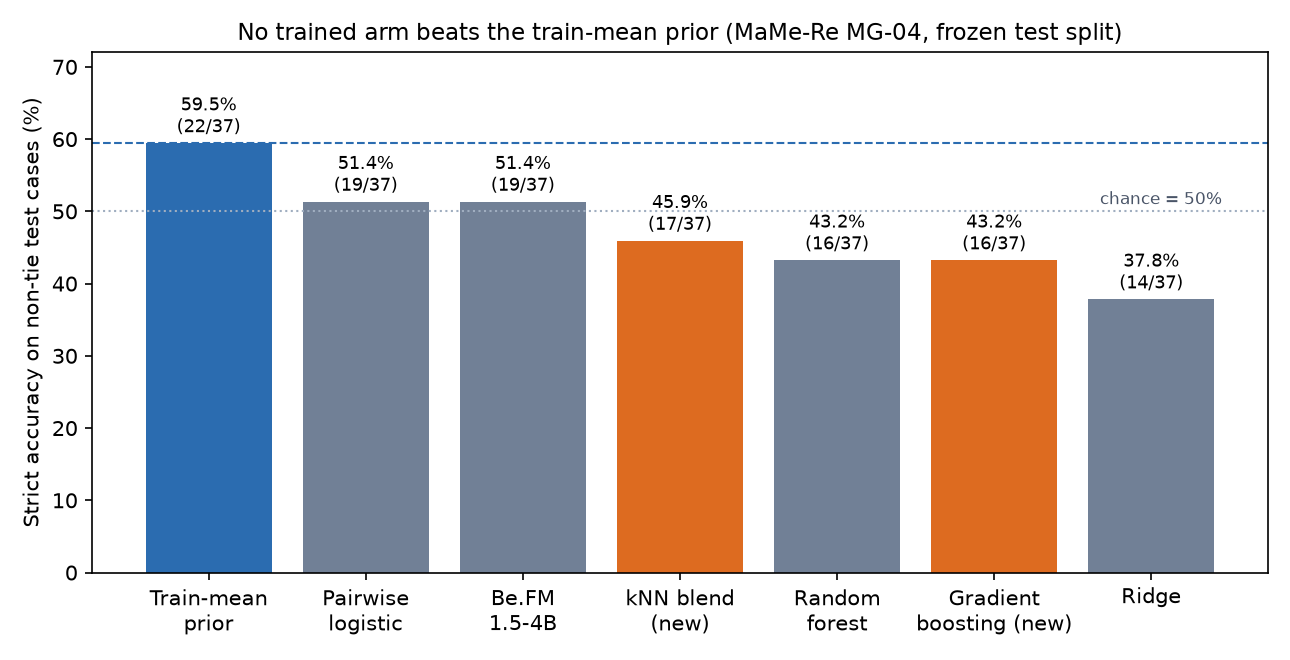 Figure 2 — Strict accuracy on the 37 non-tied frozen test cases, all arms, all runs under identical conditions. The prior (blue) is the train-mean baseline; orange bars are the two arms trained on 2026-11-28; the earlier arms are from the 2026-11-12 runs. Source: our run receipts v2.0–v2.3, 2026-11-12 and 2026-11-28. Read: every trained arm sits below the dashed prior line, and two sit below the 50% chance line.
| Arm | Run date | Strict accuracy (non-tie) | Correct | Mean regret |
|---|---|---|---|---|
| Prior (train mean) | reference | 0.5946 | 22/37 | 0.1243 |
| Pairwise logistic | 2026-11-12 | 0.5135 | 19/37 | in receipt |
| Be.FM 1.5-4B (zero-shot) | 2026-11-12 | 0.5135 | 19/37 | in receipt |
| kNN blend (new) | 2026-11-28 | 0.4595 | 17/37 | 0.1568 |
| Random forest | 2026-11-12 | 0.4324 | 16/37 | in receipt |
| Gradient boosting (new) | 2026-11-28 | 0.4324 | 16/37 | 0.1622 |
| Ridge | 2026-11-12 | 0.3784 | 14/37 | in receipt |
Two readings matter. First, the validation ranking inverted on the test set: the blend that edged the prior on validation (11/26 vs 10/26) lost clearly on test (17/37 vs 22/37). With denominators of 26 and 37, that inversion is what small samples do. Second, the label ceiling is low: 25 of the 37 non-tied cases are decided by a human-score gap of 0.2, which is one rater out of five. A model cannot reliably learn a distinction the raters themselves barely make.
Trade-offs and limitations
- Cheap arms first. We accepted a real trade-off: statistical arms on CPU now, instead of waiting for GPU capacity to retry LLM fine-tuning under the same gate. The cheap question — can anything beat the average on this data at all — deserved an answer before the expensive one.
- Comparability over power. We kept the frozen 37-case test set so that runs months apart stay comparable, accepting low statistical power. A larger, fresher test set would give tighter numbers and break every historical comparison we have.
- Benchmark, not product. MaMe-Re measures taste for manga panels. It is the comparison surface we have with human ground truth; it is not evidence about how people respond to our product's interventions.
What we have not verified
- LLM fine-tuning under this gate. An earlier small SFT run (SmolLM2-135M, on a different public dataset) failed its own gate on 2026-11-14. A matched LLM arm on MaMe-Re needs GPU capacity we do not currently have verified access to; it has not run.
- Product data. Our app does not yet log which candidate wording was chosen with what probability, so verified real intervention cases number zero. Whether product data behaves like this benchmark is unknown.
- Be.FM's weights carry a license inconsistency we documented in November; we evaluate the model for research and never load its weights commercially.
Try it, or run it with us
The dataset is public and the method above is complete enough to replicate: pin the data, freeze the split, pin the cases, reproduce the control, then train. If your arm beats 22/37 under the same gate, we want to hear how — that result would change what we ship. The model this gate protects chooses the words our app shows people who are having a hard day; it does not get replaced on a validation win. Our company's numbers, including this research program's costs, are published on our /open page, and the app the predictor serves is on the App Store via our site.
Further reading
- MaMe-Re dataset and code (CyberAgent AI Lab) — the benchmark, its license, and the data this run pins.
- Volume is not a test: what creative variant testing requires — the sibling gate we built for creative testing, same day, same discipline.
- Anicca /open — our revenue, costs, and metrics, published.
- The affirmation app this predictor serves — the product surface where a promoted model would land.
FAQ
- What does this article say about "The problem: a training claim we could not cash"?
- Our behavior model, Manager, has one job: predict which of two candidate messages a person will respond to better, so the intervention we send is the better one.
- What does this article say about "How we did it"?
- The gate, applied to the published result file:
- What does this article say about "Results"?
- Two readings matter. First, the validation ranking inverted on the test set: the blend that edged the prior on validation (11/26 vs 10/26) lost clearly on test (17/37 vs 22/37).
- What does this article say about "Try it, or run it with us"?
- The dataset is public and the method above is complete enough to replicate: pin the data, freeze the split, pin the cases, reproduce the control, then train.
Subscribe to the next one
An Anicca research note. Every number in this note is measured and sourced in the text. Source of truth lives at this URL; all other channels mirror back here.
More in Research
- Volume is not a test: what creative variant testing requires, and what our own gate found
- Frozen Manager adapters fail a cross-study prior comparison
- Reducing gradient conflicts does not guarantee better multi-task behavior prediction
- Matched SFT and DPO training still loses to a simple prior
- Introducing Manager: one model, one eval, one product
- Behavioral anomaly detection: change is not proof of harm