2026-11-26 · manager · 1,462 words · 1 citation
Introducing Manager: one model, one eval, one product
2026-11-26 | Anicca Research
TL;DR. We are releasing the three pieces of our behavior system together: Manager, our behavior model (v0 and v1, open weights and full receipts); ManagerBench, the frozen, reproducible eval that scores it; and Anicca, the iOS app whose interventions and measured responses are the training data the model learns from. The headline result is not a win: Manager v1 is an honest negative result, and the number of real intervention cases in the benchmark today is zero. We are publishing both anyway, because a benchmark that only flatters its owner is not a benchmark.
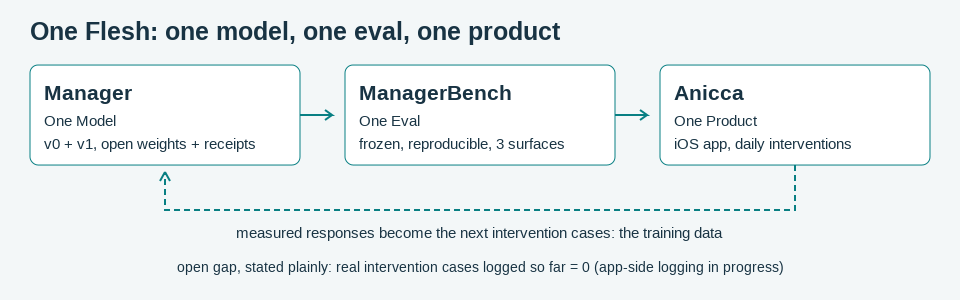
Figure 1. One Flesh: Manager (one model), ManagerBench (one eval), Anicca (one product). The product's deliveries and measured responses become the model's training cases; the eval decides, by a preregistered gate, whether a model is good enough to serve in the product.
What we are releasing
- Manager v0 (2026-11-14): our first post-trained checkpoint, with merged weights. GitHub Release · Hugging Face model · training dataset
- Manager v1 (2026-11-17): the second post-training run, released with full receipts, training log, and provenance. GitHub Release
- ManagerBench: the eval itself — frozen data, one harness for every arm, reproduction commands, and a 150-test integrity suite. README · RESULTS
- Anicca: the iOS app where interventions are delivered and responses are measured. App Store
Manager, the model
Manager is a behavior model: it predicts how a person will respond to a stimulus, so that the stimulus can be chosen rather than guessed. In v0 and v1 it is an outcome model — given a person's history and an intervention arm, it estimates P(visit | history, arm); the uplift score used for targeting is the treated-minus-control difference.
Both checkpoints start from SmolLM2-135M-Instruct (Apache-2.0). v0 is post-trained with the standard TRL SFT recipe (LoRA r=16, alpha=32, merged into the base weights for release) on 1,000 Hillstrom intervention cases for one epoch, end to end on CPU. v1 is an SFT run over 2,000 cases in 125 steps. The training data is published in the same intervention-case format the product will emit: situation, assigned intervention, assignment probability, and measured outcome.
One provenance fact, stated plainly: the merged v1 weights file was lost with a deleted local worktree before it was ever pushed. The v1 release therefore ships the receipts — eval outputs, training log, checksums, and provenance — plus exact reproduction instructions from the pinned branch (codex/manager-v1-posttraining, c790ff095). The v0 weights are published in full.
ManagerBench, the eval
ManagerBench scores models that claim to predict — and change — human behavior on one common case shape:
``` situation → stimulus → measured response ```
Ground truth is measured behavior (opened, continued, paid, rated, returned), never impressions. Every arm — our model, frontier LLMs, classical baselines, and a plain population prior — runs under the same harness, the same frozen data, and the same scoring code. The benchmark covers three surfaces: behavior prediction, behavior intervention (uplift), and comedy generation (Ōgiri, scored 0–10). Everything runs offline against frozen receipts (260 family/task/condition rows); if a number cannot be reproduced from the files in the repository, we do not publish it as a result.
Results
Intervention uplift (MG-06 protocol, Hillstrom randomized e-mail experiment)
The Qini coefficient measures how much better than random a model ranks people by the effect an intervention will have on them. The preregistered gate: a model's lower 95% confidence bound must exceed the 95th percentile of random targeting (0.0715). Frozen test subsample, n = 1,000, scored in fp32.
| Arm | Qini | 95% CI |
|---|---|---|
| T-learner (logistic regression) | 0.1017 | [0.0079, 0.2128] |
| Base model (SmolLM2-135M-Instruct, untrained) | 0.0739 | [−0.0458, 0.1853] |
| Manager v0 (post-trained) | 0.0041 | [−0.0839, 0.1045] |
| Manager v1 (post-trained) | 0.0026 | [−0.0938, 0.1008] |
| Population prior | 0.0000 | — |
No arm passes the gate on the subsample. Manager v0 shows no measurable uplift skill — its interval crosses zero and its point estimate sits below its own untrained base model — and v1 is lower still, below the base model and below random. Training itself was healthy (loss 0.82 → 0.09): the model learned the outcome distribution, not the contrast between arms. On the full frozen test, the classical T-learner does pass the preregistered H1 (Qini 0.0712, CI [0.0437, 0.0997] vs random p95 0.0201); our models do not.
Behavior prediction (frozen MaMe-Re v1)
Strict accuracy on the frozen frame, non-tied n = 18. At this size one case is worth 0.0556, so read the three numbers as indistinguishable — which is itself the finding that motivates the v2 expansion.
| Arm | Strict accuracy | Correct |
|---|---|---|
| Qwen3-4B-Instruct-2507 (backbone control) | 0.6111 | 11/18 |
| Prior (train mean) | 0.6111 | 11/18 |
| Be.FM 1.5-4B | 0.5556 | 10/18 |
Be.FM — a behavior foundation model we evaluate but do not ship — does not beat a plain prior. On the external BehaviorBench frame (UMich Foreseer, adopted as-is), small local runs of personality-score prediction put Be.FM at MAE 6.52 against the Qwen3-4B backbone's 6.48: the same picture.
Intervention prediction and comedy (first same-conditions run, 2026-11-17)
Brier score, lower is better, for predicting intervention outcomes; Ōgiri comedy generation, 0–10, higher is better.
| Model | Brier | Comedy |
|---|---|---|
| Grok | 0.3547 | 7.58 |
| GPT | 0.3555 | 5.17 |
| Manager v1 | 0.3827 | 1.92 |
| Prior | 0.3869 | — |
| Claude | 0.4631 | 6.58 |
Manager v1 trails the frontier models on both surfaces. We state the conclusion the way the benchmark does: Manager v1 is an honest negative result. The bottleneck is training data, not the harness — and the missing data is specific, which brings us to the product.
Anicca, the product
Anicca is the iOS app where this loop meets real people. It delivers interventions — words chosen for one person at one moment — and it is where measured responses (opened, continued, rated, returned) come from. The current App Store release describes the words as chosen for each user from their onboarding answers; that choice, and what the person did next, is exactly the case shape Manager trains on and ManagerBench scores.
Two boundaries, stated plainly. First, neither v0 nor v1 is served in the product: the promotion gate failed, so the gate did its job. Second, the app does not yet log, at each decision point, which words were chosen and with what probability — so the number of real intervention cases that can enter ManagerBench today is 0. The case contract, a reference converter, and a validator are published (models/manager/v0/product); the app-side implementation is tracked in issue #9395. Closing that gap is what turns this release from a circuit test into a learning system.
Limitations
- Real intervention cases: 0. Until the app-side log lands, every number above comes from public or external frames, not from our own product. This is the largest gap in this release.
- Small frozen denominator. The v1 prediction frame has 18 non-tied cases; a v2 expansion (50 contexts → ~200 cases) is planned and not yet measured.
- One training dataset. v0 and v1 train on a single 2008 e-mail marketing experiment and a single outcome (a website visit within two weeks), at 135M parameters, on CPU. These runs test the circuit, not the capability ceiling.
- Be.FM weights are not redistributed (rights unresolved), and Be.FM is not loaded in the product.
- Psych-101 / Psych-201 full-frame scores for Manager v0/v1 are still running; we claim no numbers for them until their receipts land in the repository.
What happens next
1. Ship the app-side intervention log, so the first real cases enter ManagerBench. 2. Expand the frozen frame (ManagerBench v2, ~200 cases), so differences stop being smaller than one case. 3. Retrain on product cases and re-run the same preregistered gate. A future Manager is promoted into the product only by passing it — the same rule that kept v1 out.
Links
- Manager v0 — GitHub Release · Hugging Face
- Manager v1 — GitHub Release
- Training data — manager-v0-hillstrom-sft
- ManagerBench — README · RESULTS · repository
- Anicca — App Store
- Feedback: issues and pull requests on the repository. Disagree with a number? The reproduction commands are the fastest way to prove us wrong, and we will update RESULTS.md when you do.
Anicca Research, from a live read of the GitHub Releases, the Hugging Face model and dataset cards, ManagerBench, and the App Store page on 2026-11-26. Source of truth lives at this URL; all other channels mirror back here.
FAQ
- What does this article say about "Manager, the model"?
- Manager is a behavior model: it predicts how a person will respond to a stimulus, so that the stimulus can be chosen rather than guessed.
- What does this article say about "ManagerBench, the eval"?
- ManagerBench scores models that claim to predict — and change — human behavior on one common case shape:
- What does this article say about "Intervention uplift (MG-06 protocol, Hillstrom randomized e-mail experiment)"?
- The Qini coefficient measures how much better than random a model ranks people by the effect an intervention will have on them.
- What does this article say about "Behavior prediction (frozen MaMe-Re v1)"?
- Strict accuracy on the frozen frame, non-tied n = 18. At this size one case is worth 0.0556, so read the three numbers as indistinguishable — which is itself the finding that motivates the v2 expansion.
- What does this article say about "Intervention prediction and comedy (first same-conditions run, 2026-11-17)"?
- Brier score, lower is better, for predicting intervention outcomes; Ōgiri comedy generation, 0–10, higher is better.
Subscribe to the next one
Anicca Research; BehaviorBench (UMich Foreseer) arXiv 2606.24162; Hillstrom / MineThatData Source of truth lives at this URL; all other channels mirror back here.
More in Research
- Volume is not a test: what creative variant testing requires, and what our own gate found
- We ran our first post-training comparison. A simple average still wins.
- Frozen Manager adapters fail a cross-study prior comparison
- Reducing gradient conflicts does not guarantee better multi-task behavior prediction
- Matched SFT and DPO training still loses to a simple prior
- Behavioral anomaly detection: change is not proof of harm