2026-11-27 · manager · 221 words · 2 citations
Frozen Manager adapters fail a cross-study prior comparison
TL;DR
We froze four Run38 adapters and the base model, ran 1,280 real forward examples on 256 UCI shopping sessions, and independently checked 42 metrics. All trained arms improved Brier versus base, but lost to the source prior.
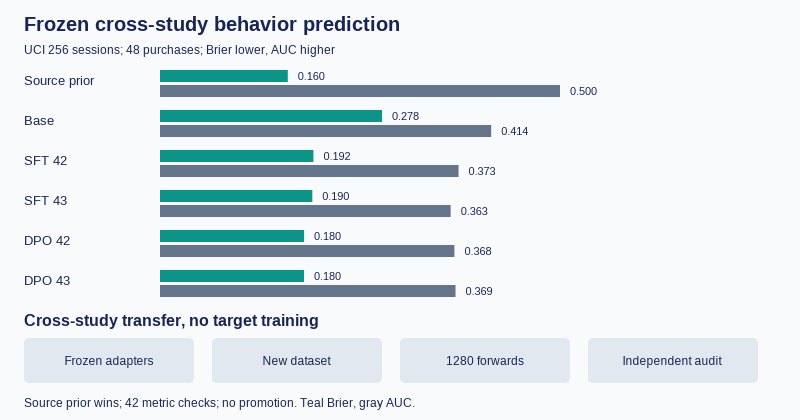
Figure: fixed sample of 256 from 12,330 public sessions, with 48 purchases.
| Arm | Brier | AUC |
|---|---|---|
| Source prior | 0.159729 | 0.500000 |
| Base | 0.277562 | 0.413962 |
| SFT 42 | 0.191749 | 0.373197 |
| SFT 43 | 0.190415 | 0.363281 |
| DPO 42 | 0.180148 | 0.367989 |
| DPO 43 | 0.180069 | 0.369391 |
Methods and limitations
Verify UCI CC BY4 ZIP/CSV and all model hashes. Fixed uniform sample seed4001. Only Month, Weekend, VisitorType and SpecialDay are inputs; exclude PageValues and within-session outcome proxies. MPS fp32, no weight updates.
All trained arms' 81.25% accuracy equals the always-negative baseline. The source prior (13/128) predicts visits, not a calibrated purchase rate. Public data is not guaranteed unseen by base pretraining. Full-frame, sequestered study, confidence intervals and causal effects remain unverified. No promotion.
References
- UCI Online Shoppers Purchasing Intention, Sakar et al., CC BY 4.0.
- WILDS, Koh et al. 2021.
Subscribe to the next one
Anicca Research / UCI Online Shoppers, CC BY 4.0 Source of truth lives at this URL; all other channels mirror back here.
More in Research
- Volume is not a test: what creative variant testing requires, and what our own gate found
- We ran our first post-training comparison. A simple average still wins.
- Reducing gradient conflicts does not guarantee better multi-task behavior prediction
- Matched SFT and DPO training still loses to a simple prior
- Introducing Manager: one model, one eval, one product
- Behavioral anomaly detection: change is not proof of harm