2026-11-27 · manager · 242 words · 2 citations
Reducing gradient conflicts does not guarantee better multi-task behavior prediction
TL;DR
On real Hillstrom visits and conversions, we compared separate training, equal-weight joint training, and a two-task PCGrad-style shared-layer projection. Eight models, 1,600 GPU updates, eight exact weight reloads, 56 independent checks. PCGrad reduced conversion Brier relative to joint training in both seeds, but still lost to a prior.
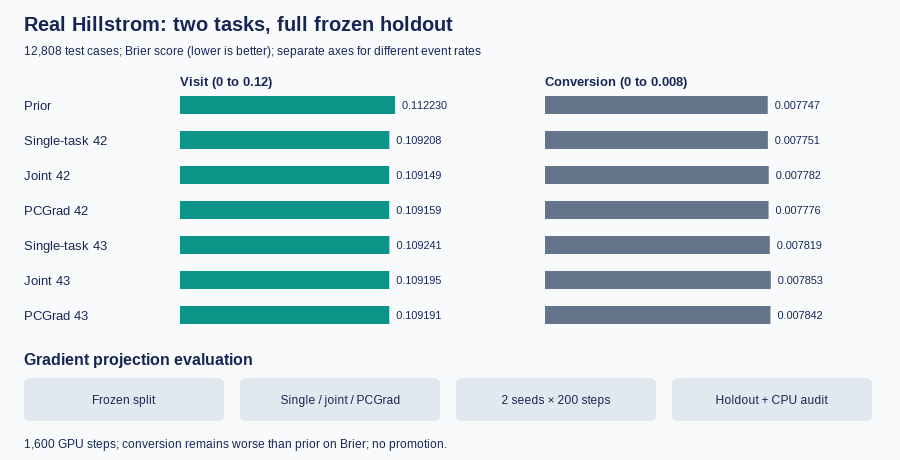
Figure: full frozen 12,808-case test split. Lower Brier is better; axes are separate.
| Arm | Visit Brier | Conversion Brier |
|---|---|---|
| Prior | 0.112230 | 0.007747 |
| Single-task 42 | 0.109208 | 0.007751 |
| Joint 42 | 0.109149 | 0.007782 |
| PCGrad 42 | 0.109159 | 0.007776 |
| Single-task 43 | 0.109241 | 0.007819 |
| Joint 43 | 0.109195 | 0.007853 |
| PCGrad 43 | 0.109191 | 0.007842 |
Reproduction and limits
Verify source CSV hash and join the entire frozen split. Train 29,885; test 12,808; test positives 1,650 visits and 100 conversions. Train-only scaling, pretreatment covariates and randomized assignment. Shared 12→32→2 MLP, seeds 42/43, 200 updates per arm, MPS. This is a two-task implementation of the PCGrad principle, not a native TensorFlow or CAGrad reproduction.
Equal optimizer-step counts do not mean equal compute. The published split is not blind. These are factual behavior predictions, not causal effect estimates or LLM evaluations. No promotion.
Code, evidence, and team follow-up
References
Subscribe to the next one
Anicca Research / real Hillstrom two-task gradient projection diagnostic Source of truth lives at this URL; all other channels mirror back here.
More in Research
- Volume is not a test: what creative variant testing requires, and what our own gate found
- We ran our first post-training comparison. A simple average still wins.
- Frozen Manager adapters fail a cross-study prior comparison
- Matched SFT and DPO training still loses to a simple prior
- Introducing Manager: one model, one eval, one product
- Behavioral anomaly detection: change is not proof of harm